Your plant already generates the data.
Nobody is recording it.
The downtime, the reason, the part that came out wrong, which machine each work order is on. Somebody knows all of it — and it is lost the moment the shift ends.
Patok Gemba turns it into data with the cheapest thing there is: a QR sticker and one tap. No PLC, nothing to wire, no changes to your machines.
Your operators are the sensors. That is why it works in your plant —with the machines you already have— and not just in the demo.
Machine
Punch Press 3
- Reason
- Tool change
- In queue
- 4 work orders
- Logged by
- Juan Pérez
One tap
The operator scans the machine's sticker. The data is born right there.
One plant. Five angles.
It is not one board for everyone. It is the same plant seen from wherever it hurts for each person — and every view brings its own numbers.
Work
The live flow
What is running, what is queued, and what has shipped — with open commitments at the top.
Supervisor
Material
Where every lot is
What was just created, where it is stored, how much is left, and what has run out.
Warehouse
Work orders
What you owe and to whom
Work orders in progress, planned, and closed — or the planner's notebook, as a live sheet.
Planning
Machines
Which one is down and why
Running, down, setup, maintenance, idle. With its queue, its bay, and its alert rules.
Production
Log
What happened today
The plant's complete chronology, whatever channel it came from.
Management
24 one-tap actions,
stuck on the machine.
These are not eight loose buttons: it is a catalog organized by the moment in the shift. The operator scans the sticker they need and the action runs — no menus, no keyboard, nothing to hunt for.
Floor Kit
Patok prints the QR sheet for each machine in A4, A3 o A1. You stick it on, and that machine is instrumented. That is the entire installation.
And one distinction that matters: the problem QR is an Andon — a call for help that escalates, not a defect record. Quality inspection is something else and lives in its own flow.
The minute-by-minute of your plant.
Wherever it comes from.
WhatsApp, email, the app, the glasses, the system. It all lands on the same timeline — and every entry says which channel it came in through.
Shop floor · operational memory
Today · Monday the 6th
- 07:12OBSWhatsAppTranscript“There's a noise coming from the decoiler”Juan Pérez · Punch Press 3
- 08:05PRDSistema47 production movements · 07:12 – 09:38Punch Press 3
- 09:42MAQAppDowntime · Tool change · 1 h 18 minPunch Press 3
- 10:26CALCorreoVisual Quality: FAIL 2/10 · burr (CRITICAL) · scrapLot L-A0912
- 11:03EVICopilotoEvidence anchored by QR · WIP-A000206Glasses · with GPS
- 11:40OBSAgenteOA-238 · Resequence the Punch Press 3 queueAssigned to Miguel Ruiz
01 · The shift starts
Things happen. Nobody writes them down.
The odd noise, the hour of downtime, the part that came out wrong, the photo someone sent over WhatsApp. It all exists — scattered across chats, emails, and the memory of whoever was there.
02 · Someone speaks
The operator dictates and it gets written down
They send a voice note over WhatsApp: “make a note that there's a noise coming from the decoiler”. It is filed with their name, their photo, and the transcript. No app to open, no form to fill in.
03 · Everything converges
Wherever it comes from, it lands in the same place
The quality email, the evidence from the glasses, the downtime the machine recorded, the action the agent assigned. Every entry carries the color of the channel it came in through.
04 · The plant has memory
And suddenly you can see the whole day
The 48-hour pulse stacks what happened by hour. Production fades back; the exception stands out. You no longer have to reconstruct the shift by asking around — it is written down.
It brings the result
It does not say QUALITY_CHECK_PERFORMED. It says “FAIL 2/10 · burr (critical) · scrap”. The fact, not the name of the event.
The real time
The time you see is the time it happened, not when the system found out. A video analyzed three hours later lands on the minute the camera saw it.
No forms
Reporting is free: a voice note is enough. Making a note does not force you to open a task — that is another layer, and it is a human's call.
Note The log is also one of the datasets Patok exposes over MCP — so you can ask it from Claude or ChatGPT without exporting anything. How it works →
0:07
Make a note that there's a noise coming from the decoiler on 3
Transcribed · saved to the log
Done. Logged on Punch Press 3 at 07:12, under your name.
How's 3 doing?
Down since 09:42 · tool change · 1 h 18 m. It has 4 work orders queued; OP-4471 is Northern Customer's and is committed for Friday.
Your people already know how to use it.
There is nothing to teach.
WhatsApp is not a notification channel: it is where the floor works. An operator sends a voice note and it is filed with their name, their photo, and the transcript — no app to open, no form to fill in.
Es el same engine and the same thread that serves the glasses, the handheld console, and the web chat. A question asked by voice shows up in the conversation the team sees, tagged with where it came from.
Before releasing more work,
the floor tells you whether you can.
You select what you were about to release and, before confirming, Patok projects the effect: how much WIP would be left against your limit, how the bottleneck queue grows, and whether material covers it.
WIP on the floor
18 → 24
limit 22
Bottleneck
Punch Press 3
queue 4 → 7
Material
4 de 6
two without coverage
Lead time
2.2 d
Little's Law · real data
Releasing all 6 would leave the bottleneck queue at 7 work orders. Release 4 today and leave the P2s for tomorrow.
Little's Law
Lead time comes from the WIP and throughput you actually measured. And the screen tells you where the number came from: real data, simulation, or a routing estimate.
Release gate
A ceiling on work in process. When you hit it, the gate closes: no new order goes in until one comes out.
Availability × Performance × Quality
It is calculated from the downtime and inspections that were actually recorded. If a factor is missing, it comes back blank instead of invented.
What nobody else does
Patok tells you when it does not know.
If nobody inspected, the OEE quality factor comes back blank — not at 100%. If there is no reference cycle time, it does not invent a performance figure. And the morning report grays out what is not instrumented yet, instead of filling it in.
When a machine goes down,
two clocks are running.
One is the alarm: it escalates on its own by levels, at the minutes you define, to the people or groups you choose, through the app, push, WhatsApp, or email. The other is the task: someone takes it, resolves it, and closes it with a note.
And critical alerts ignore notification preferences on purpose. An escalated stoppage is operations, not marketing.
The detail nobody else has
The system does not lie to you about whether the alert arrived.
Push· 3 sent· 1 with no device
WhatsApp· 2 sent· 1 outside the window
Instead of a "sent" that means nothing.
- 0
Operator and line supervisor
AppPush - 15
Production manager
PushWhatsApp - 45
Plant manager
WhatsAppEmail
The downtime reasons are yours and are configured per machine — and they come out sorted in a Pareto so you know which one to attack.
"Picked up." "Delivered."
Moving material gets coordinated by shouting, over the radio, or on WhatsApp — and none of it leaves a record. Patok turns it into a task with an owner, a time, and evidence, on a screen made for a tablet and for gloved fingers.
It gets verified
The QR of the origin, the unit, and the destination are scanned. Verification can be skipped, but the system requires writing down why — and it is recorded.
It leaves a trail
A printed trip ticket that sticks to the material, and that applies the delivery when scanned. Inventory changes on confirmation, not on acceptance.
It gets measured
Delivered, in progress, exceptions, and average delivery time — broken down by operator.
The movements module is switched on during implementation, once the plant has the rest running.
When someone asks you
that you prove it.
An audit, a customer claim, a certification. That is the moment a shop floor system earns its keep or loses it.
Traceability ticket
From the skid you ship to the raw material lot it came from. In one PDF.
Every WIP on that skid, the materials each one consumed, the inspections it passed, which machine made it, and what it cost. The chain assembles itself because the operator scanned the material as they consumed it.
Walks and audits
A finished audit is not a PDF: it is assigned work.
Every "does not comply" becomes an action with an owner, and it reaches whoever has to resolve it. And the series report tells you how many findings are still open, how many are overdue, and how many hours they take to close on average.
The walk is done with the console in hand: every stop is verified by scanning the machine's QR, with a time and a position. Afterwards the whole walk can be replayed on the map.
How your work orders come in
Any ERP knows how to send an email.
You forward the purchase order —a PDF, a spreadsheet, or plain text— and Patok drafts it with customer, product, quantity, and date. You confirm it. No API, no connector, no IT project.
It runs on what your people
already has in hand.
The operator's phone is enough to start. And when the plant asks for it, there is a native console that runs on a watch, a PDA, and a tablet — the same app, adapting itself to the screen size.
The same app on the watch, the PDA, and the phone.
It adapts itself
It detects whether it is running on a two-inch wrist or on a tablet and sizes the buttons for a gloved finger.
It works with no network
Every action is saved on the device first. When the signal comes back, everything goes in in the real order it happened, with its original time.
It prints labels
The PDA's built-in printer or a 58 mm thermal over Bluetooth. An entity label with its QR and its lineage.
It scans with a gun
If the device has a laser reader, it works just like the camera. Nothing to configure.
It installs from a QR and updates itself: you cut the version and every device gets the notice immediately, verifying the fingerprint before installing. It does not go through app stores.
AI glasses
Optional peripheralA button at the temple, a photo of what you are looking at, and the answer comes back spoken in your ear. If the photo contains a machine's QR, the conversation is anchored to that machine.
Built and tested with the hardware in hand. They need a paired Android phone nearby, and they have no screen: the answer is voice only.
Beacons · Patok Mesh
Enabled per plantBluetooth tags to find a lot with a hot-and-cold radar, take a census of an area, or know what was nearby when something happened.
They are configured from Patok, without the manufacturer's app. It is switched on during implementation; it does not come active out of the box.
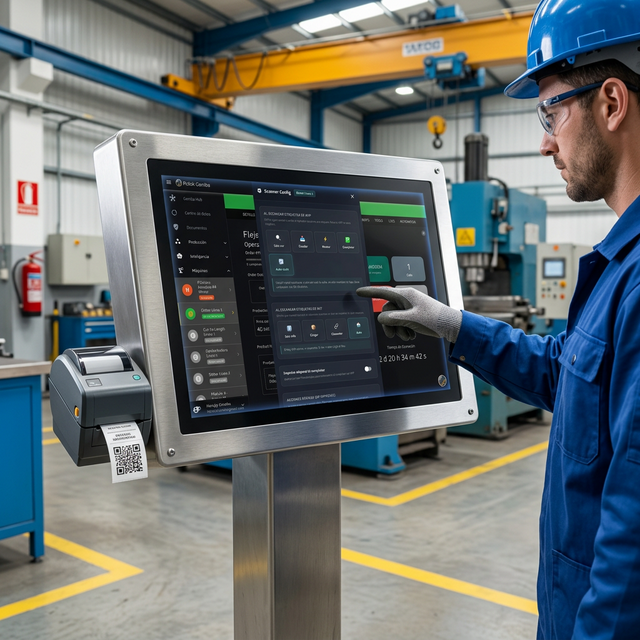
Industrial kiosk
A tablet mounted on the machine, with a reader and a label printer. The complete station for a high-volume line.
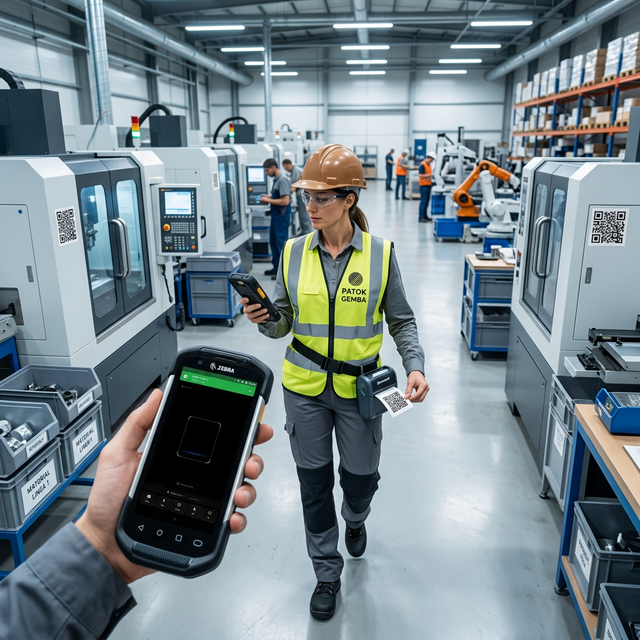
Gemba Walker
A ruggedized PDA for whoever walks the floor. Scan, review, and print without going back to the office.
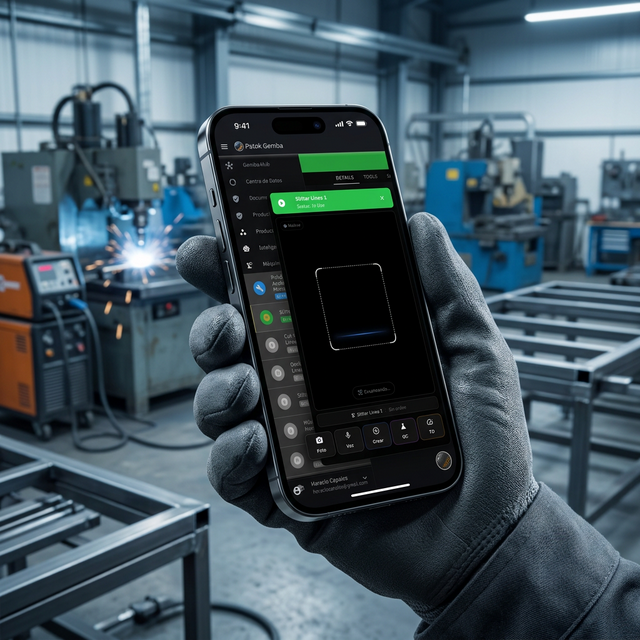
The operator's phone
What they already have in their pocket. Scan the QR with the camera and log it instantly, with nothing to install.
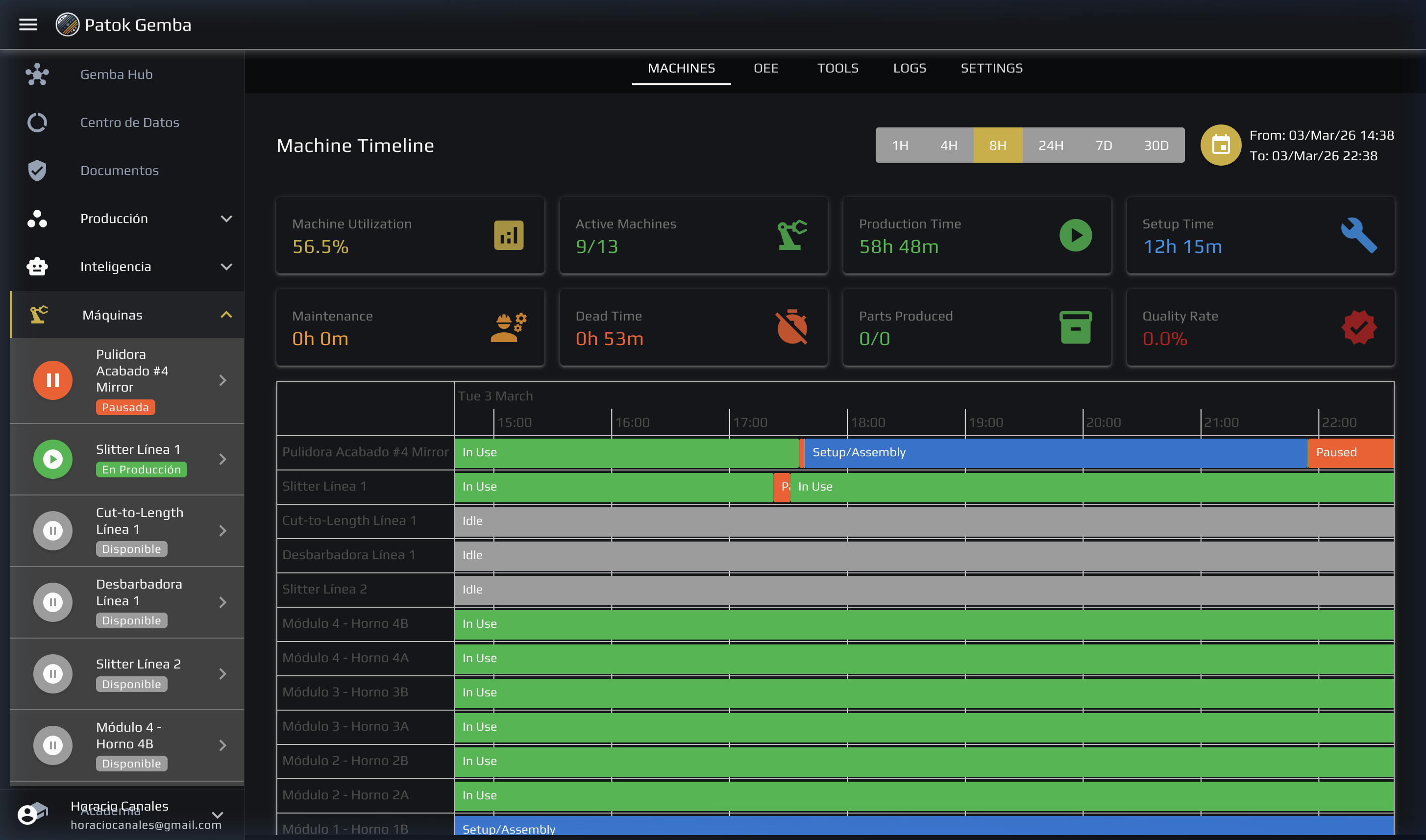
The software exists.
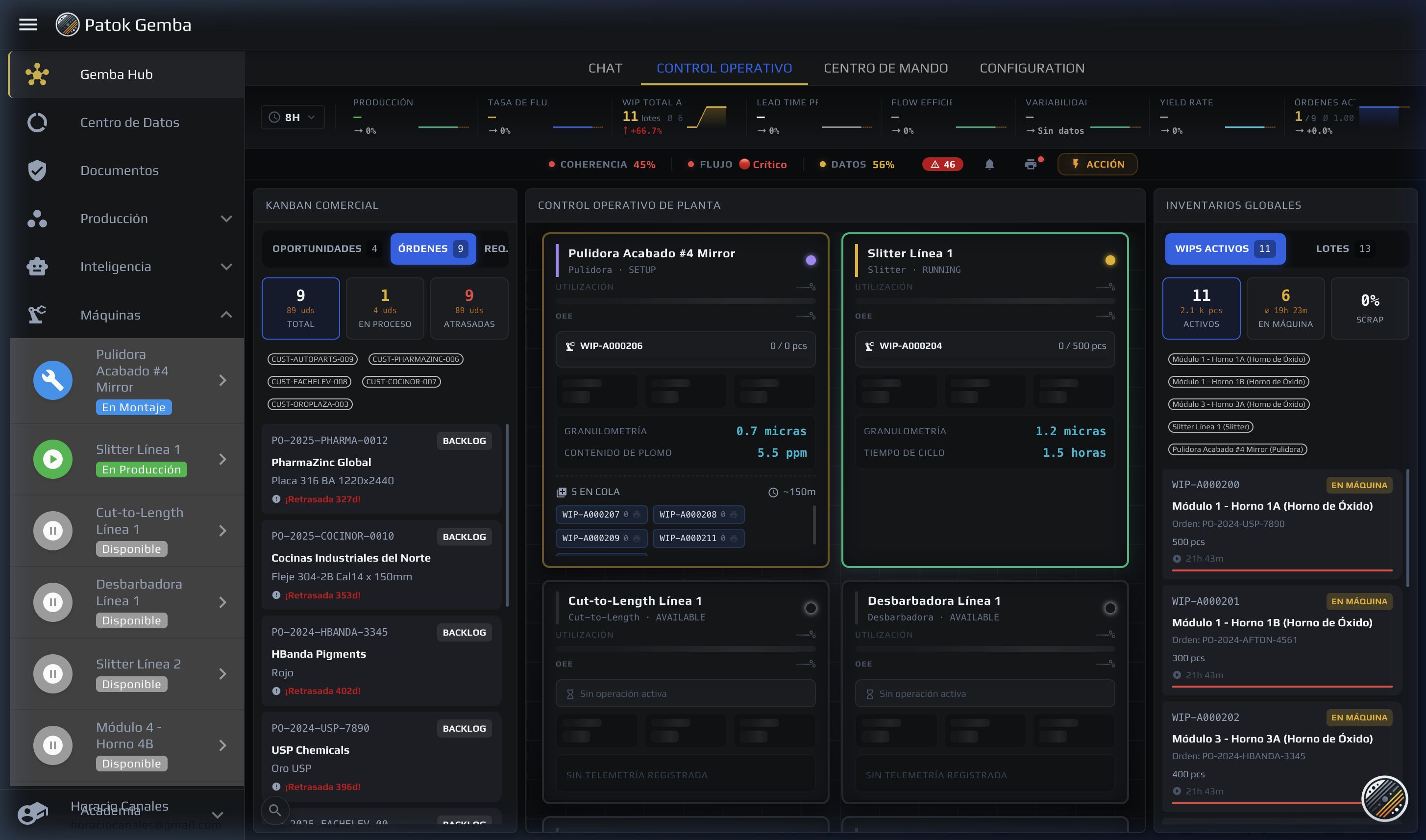
Screenshots of the platform, exactly as they look.
Start with one machine.
A sticker and one tap.
Send us a file from your operation —or let us look at one machine— and we will tell you what can be measured from the first week, and what cannot.
No new sensors · No ERP changes · Start with one machine