The ROI of Digitizing Your Plant: How to Calculate It Step by Step
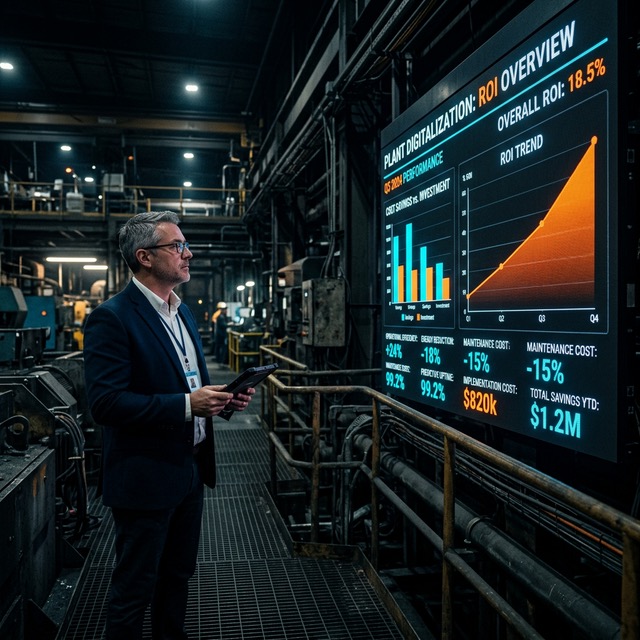
Learn how to calculate the return on investment of digitizing your manufacturing plant. Formulas, real examples, and the 5 quantifiable benefits that justify the spend.
The ROI of Digitizing Your Plant: How to Calculate It Step by Step
"I want to digitize the plant, but how do I justify it to the board?"
This is the question that stops most digitization projects at industrial SMBs. Not because there is no value — but because nobody knows how to quantify it in a way a CFO understands.
This guide gives you the tools to calculate ROI concretely, with real numbers, clear formulas and examples you can adapt to your plant.
The Basic ROI Formula
ROI = (Net Benefit - Total Investment) / Total Investment × 100%
For plant digitization, you need to quantify two things:
- Total investment: what does it cost to implement?
- Net benefit: how much money do you generate or save?
Let's break down each one.
Step 1: Calculate the Total Investment
Initial Investment (Month 0)
| Item | Typical range (10 machines) | Notes |
|---|---|---|
| Android tablets for workstations | $2,000 - $4,000 | $200-400 per tablet, one per key station |
| Industrial mounts | $300 - $500 | To mount tablets at the workstations |
| Thermal QR printer | $300 - $500 | To print per-part labels |
| QR stickers / labels | $50 - $100 | To identify machines |
| Initial configuration | $0 - $500 | With Patok, setup is included. With an MES, multiply by 50× |
| Total initial investment | $2,650 - $5,600 |
Recurring Cost (Monthly)
| Item | Typical range | Notes |
|---|---|---|
| Platform subscription | $200 - $800/month | Depends on machine and user count |
| QR labels (consumable) | $20 - $50/month | For new parts |
| Technical support | Included | With Patok, support is in the subscription |
| Monthly total | $220 - $850/month |
Investment Comparison
| Solution | Initial investment | Monthly | Implementation |
|---|---|---|---|
| Digital Twin (Patok) | $3K - $6K | $200 - $800 | 1-2 weeks |
| Traditional MES | $100K - $500K | $2K - $10K | 6-18 months |
| IoT + SCADA | $50K - $200K | $1K - $5K | 3-12 months |
| ERP with production module | $200K - $1M+ | $5K - $20K | 12-24 months |
For a detailed comparison of these options, read our article on Digital Twin vs SCADA vs MES.
Step 2: Identify the Quantifiable Benefits
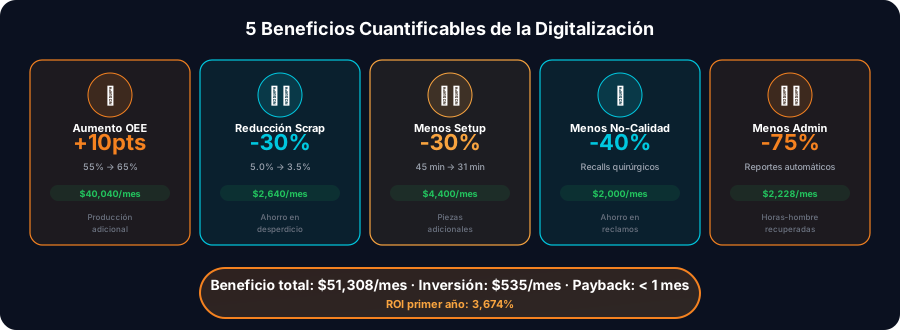
This is where most analyses fail — because they list generic benefits like "better efficiency" without attaching a number. Let's be concrete.
Benefit 1: Higher OEE
The data: the average plant without digital measurement runs an OEE of 45-65%. Once it starts measuring digitally and acting on the data, OEE typically improves 10-15 points in the first 6 months.
The calculation:
Current output: 1,000 parts/day
Average selling price: $10/part
Current OEE: 55%
OEE after digitization: 65% (+10 points)

Additional output = 1,000 × (65/55 - 1) = 182 extra parts/day
Additional revenue = 182 × $10 × 22 days/month = $40,040/month
A 10-point increase in OEE can mean $40,000+/month in additional output for a mid-size plant.
Benefit 2: Less Scrap
The data: with digital Poka-Yoke and part-level traceability, scrap rates typically fall 20-40% in the first 3 months.
The calculation:
Current scrap: 5% of output = 50 parts/day
Cost per part (raw material + machining): $8
Monthly scrap cost: 50 × $8 × 22 = $8,800/month

Reduction after digitization: 30%
Scrap savings: $8,800 × 30% = $2,640/month
Benefit 3: Shorter Setup Times
The data: without measurement, setups usually take 30-60% longer than necessary. Digital visibility plus standardization cuts setups by 25-40%.
The calculation:
Setups per day: 6
Current average time: 45 min
Reduction from digital standardization: 30% = 13.5 min per setup

Time recovered/day: 6 × 13.5 = 81 min/day
Additional parts produced: 81 min / 4 min cycle time = 20 parts/day
Additional revenue: 20 × $10 × 22 = $4,400/month
Benefit 4: Lower Cost of Poor Quality
The data: with part-level traceability, recalls go from mass to surgical. Claims get resolved in minutes, not days.
The calculation:
Current cost of poor quality (rework + scrap + claims): $5,000/month
Estimated reduction with digital traceability: 40%
Savings: $5,000 × 40% = $2,000/month
Benefit 5: Less Administrative Time
The data: supervisors and quality staff spend 2-4 hours a day on manual logging, hunting for information and preparing reports. Digitization removes 70-80% of that work.
The calculation:
People affected: 3 (2 supervisors + 1 quality)
Hours/day on manual tasks: 3 hours average
Hourly cost: $15
Reduction: 75%

Savings: 3 people × 3 hrs × $15 × 75% × 22 days = $2,228/month
Step 3: Calculate the ROI
Summary of the Example
| Item | Monthly |
|---|---|
| Benefits | |
| Additional output from OEE | $40,040 |
| Scrap savings | $2,640 |
| Additional output from setup | $4,400 |
| Cost of poor quality savings | $2,000 |
| Administrative savings | $2,228 |
| Total benefits | $51,308/month |
| Costs | |
| Platform subscription | -$500 |
| Consumables | -$35 |
| Total recurring costs | -$535/month |
| Net monthly benefit | $50,773/month |
First-Year ROI
Initial investment: $5,000
Annual recurring costs: $535 × 12 = $6,420
Total year-1 investment: $11,420

Annual benefits: $51,308 × 12 = $615,696
(Note: benefits accumulate gradually — let's use 70% to stay conservative)
Adjusted benefits: $615,696 × 70% = $430,987

ROI = ($430,987 - $11,420) / $11,420 × 100% = 3,674%
Payback period: under 1 month.
Even being extremely conservative and using only 20% of the calculated benefits, the ROI is +900% in the first year.
The Table That Convinces the CFO
| Metric | Without digitization | With digitization | Difference |
|---|---|---|---|
| OEE | 55% | 65% | +10 points |
| Scrap | 5.0% | 3.5% | -30% |
| Average setup | 45 min | 31.5 min | -30% |
| Time to resolve a claim | 4-8 hours | 15 minutes | -95% |
| Recall cost | The whole lot | Only affected parts | -90% |
| Production reports | 3 hrs/day manual | Automatic | -100% |
| Initial investment | - | $5,000 | - |
| Payback | - | < 1 month | - |
Arguments That Always Work (and Those That Don't)
✅ Arguments That Work
1. "We are already losing money" Not digitizing has a cost — the cost of invisible inefficiency. If your real OEE is 55% and you think it's 75%, you are losing 20 points of productivity you don't even know exist.
2. "Payback is in weeks, not years" Unlike an ERP or MES that takes 12-18 months to implement and another 12 to show ROI, a Digital Twin shows results in the first week of data.
3. "Our competitors are already doing it" Between 30 and 40% of industrial SMBs in Latin America have already started some form of digitization. Those who haven't are losing competitiveness every month.
❌ Arguments That Don't Work
1. "It's the future" — the CFO lives in the present. Talk about current costs, not futuristic visions.
2. "Industry 4.0" — a buzzword that raises more doubt than confidence. Talk about OEE, scrap, setup — words the CFO understands.
3. "Others are doing it" — without concrete data from YOUR plant, this is anecdote. Run the numbers with YOUR figures.
How to Run the Calculation for YOUR Plant
The Data You Need to Gather
- Daily output — average parts/day
- Average selling price per part
- Current scrap rate (% of output)
- Raw material cost per part
- Number of setups per day and average time
- Hours spent on manual reports per person per day
- Average monthly cost of claims/recalls
With those 7 numbers you can apply the formulas in this guide and get an ROI specific to your plant.
The Shortcut: A Diagnostic Gemba Walk
If you don't have all those numbers — which is normal, and exactly why you need to digitize — a diagnostic Gemba Walk lets you estimate your real OEE, identify your main sources of loss, and calculate the potential ROI in a single session.
Conclusion: The ROI of Doing Nothing Is Negative
Every day without digital visibility is a day when:
- You lose output to bottlenecks you can't see
- You produce scrap you could have prevented with digital Poka-Yoke
- Your supervisors spend hours on paperwork they could spend improving
- Your real OEE is 15-20 points below what you believe
The investment to digitize 10 machines is less than the cost of one month of invisible inefficiency. ROI is not the right question — the right question is: what is not doing it costing you?
Want to calculate the ROI specific to your plant? Book a free diagnostic Gemba Walk — in an hour we estimate your real OEE and hand you a business case ready to present to your board.
Topics
Related Articles
More on ROI & Use Cases
Ready to transform your plant?
Book a free adoption session and find your biggest opportunity to improve with industrial AI.
Book an Adoption Session