Production Bottlenecks: How to Find Them and Remove Them

Learn how to spot bottlenecks on your production line, understand their real impact on throughput, and apply practical strategies to remove them.
Production Bottlenecks: How to Find Them and Remove Them
Your plant can only produce as fast as its slowest workstation. That is the simplest definition of a bottleneck — and one of the most ignored truths in manufacturing.
You can have 10 CNC machines running at 95% efficiency, but if your single inspection station processes at half the speed, your throughput is that station's throughput. The rest of the equipment is building work in process, not finished product.
What Is a Bottleneck?
A bottleneck is any resource — machine, person, process — whose capacity is lower than the demand placed on it. It is the constraint that caps the throughput of the whole system.
Eliyahu Goldratt's Theory of Constraints (TOC) states it plainly:
"The throughput of any system is determined by its constraint. Improving any resource other than the constraint does not improve the system."
Which means optimizing the OEE of a machine that is not the bottleneck does not affect your output. It is wasted effort.
How to Find Bottlenecks
Visual Signs on the Floor
- WIP piling up: wherever you see material stacking up in front of a workstation, there is probably a bottleneck. If 50 parts wait before your CNC and only 5 sit after it, that CNC is your constraint.
- Starved workstations: the stations downstream of the bottleneck have waiting time — operators standing idle, waiting for material.
- Recurring overtime: if you always need overtime at the same station to hit the schedule, you have a bottleneck.
The Analytical Method: Cycle Time vs Takt Time
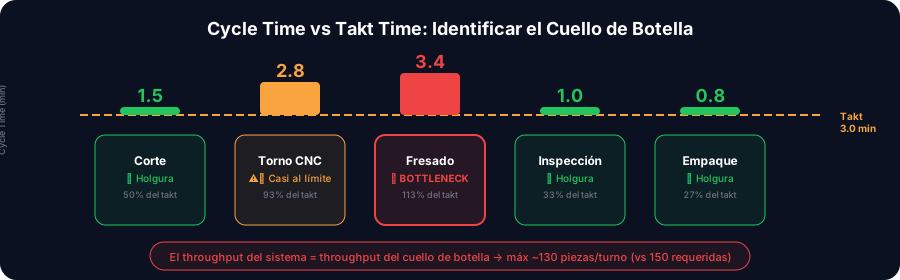
The most precise way to identify a bottleneck is to compare each workstation's cycle time against takt time:
| Workstation | Cycle time | Takt time | Bottleneck? |
|---|---|---|---|
| Cutting | 1.5 min | 3.0 min | ✅ Slack |
| CNC lathe | 2.8 min | 3.0 min | ⚠️ Nearly at the limit |
| Milling | 3.4 min | 3.0 min | 🔴 Bottleneck |
| Inspection | 1.0 min | 3.0 min | ✅ Slack |
| Packing | 0.8 min | 3.0 min | ✅ Slack |
In this example, Milling is the bottleneck: its cycle time (3.4 min) exceeds takt time (3.0 min). However much you optimize the rest, maximum output will be ~130 parts per shift instead of the 150 required.
The 5 TOC Steps to Remove Constraints
Goldratt proposes a cyclical five-step process:
1. Identify the Constraint
Find the workstation with the highest cycle time relative to its demand. Don't assume — measure. Real bottlenecks don't always match the team's perception.
2. Exploit the Constraint
Get the most out of the bottleneck without spending anything. That includes:
- Eliminating every kind of waiting at that station (material ready, tooling ready, dedicated operator)
- Zero unplanned stoppages (preventive maintenance gets priority here)
- Cutting setup to a minimum (apply SMED)
- Making sure it never runs out of material
3. Subordinate Everything Else
Set the pace of every other workstation to the bottleneck's pace. There is no point in Cutting producing at 1.5 min/part if Milling can only process at 3.4 min/part — all you generate is work in process.
4. Elevate the Constraint
If after exploiting and subordinating you still cannot meet demand, invest in expanding the bottleneck's capacity:
- Add a machine in parallel
- Add a shift
- Subcontract that operation
- Upgrade the equipment
5. Repeat
Once you remove one bottleneck, another resource becomes the new constraint. The process never ends.
Hidden Bottlenecks
Not every bottleneck is a machine. We often find them in:
- Quality inspection: a single inspector covering the output of 5 machines.
- Setup / changeover: the machine is fast while running, but takes 45 minutes on every model change.
- Information: the supervisor who approves each work order, the ERP that takes its time generating routings, the spreadsheet somebody has to update before production can start.
- Material: the warehouse that replenishes every 4 hours instead of every hour.
These bottlenecks are harder to see because they are not physical stations — they are invisible processes that cap the flow.
Digital Detection With a Digital Twin
The most effective way to detect bottlenecks is with a Digital Twin that shows the whole flow in real time.
The Patok Digital Twin shows each machine as a card with its current state, average cycle time and queued WIP count. When one workstation accumulates WIP while the next ones sit empty, the bottleneck is visually obvious.
Patok also computes an automatic bottleneck score based on:
- The ratio of cycle time to takt time
- WIP accumulation in the queue
- Workstation utilization
- Overtime frequency
That removes the subjectivity — you no longer depend on the supervisor's perception to know what your real constraint is.
Conclusion
Bottlenecks are inevitable — there will always be a constraint in your system. What is not inevitable is being blind to them. The difference between a plant fighting late deliveries and one that runs like clockwork is the ability to see, measure and act on its constraints.
Does your plant have visibility of its bottlenecks, or does it only discover them when a customer complains? Start by measuring OEE and the cycle times of each workstation — the data will talk to you.
Want to see where your plant's bottlenecks are? Book a free Gemba Walk diagnostic and find out in under an hour with Patok.
Topics
Related Articles
More on OEE & Metrics

Ready to transform your plant?
Book a free adoption session and find your biggest opportunity to improve with industrial AI.
Book an Adoption Session