What Is a Gemba Walk? A Guide for Manufacturing Leaders
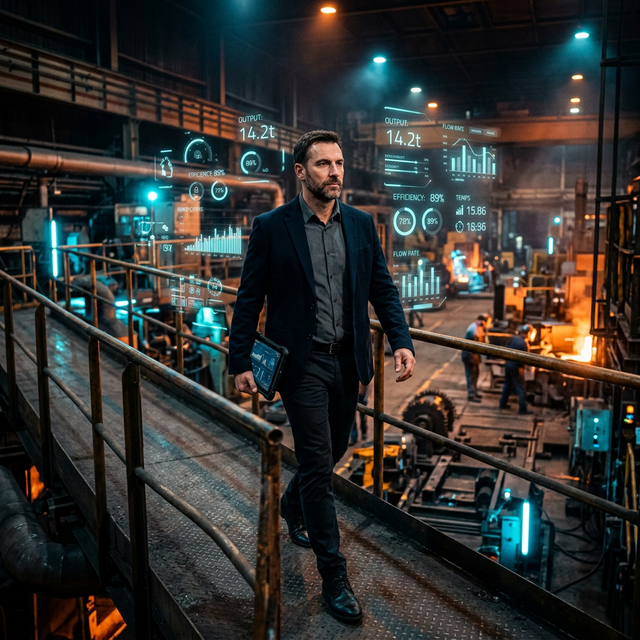
Find out what a Gemba Walk is, how to run one properly, the key questions to ask, and how to digitize it so you get real data from your plant.
What Is a Gemba Walk? A Guide for Manufacturing Leaders
Gemba (現場) means "the real place" in Japanese — where things actually happen. In manufacturing, the gemba is the production floor. And the Gemba Walk is the act of going to that place to observe, listen and understand the reality of your operation.
It is not an audit. It is not an inspection. It is not a walk to hand out orders. It is an exercise in operational humility: the leader goes to the floor to learn, not to teach.
Origin and Philosophy
The Gemba Walk is a pillar of the Toyota Production System (TPS). Taiichi Ohno — the father of Lean Manufacturing — was famous for drawing a circle on the plant floor and asking an engineer to stand in it and observe for hours, until they genuinely understood the process.
The philosophy is simple: the real problems are on the floor, not in the office. Spreadsheets, reports and meetings can lie. The reality of the floor cannot.
How to Run a Gemba Walk Properly
1. Go With a Purpose, Not an Agenda
A Gemba Walk is not a roaming meeting. Go with a question or a focus area: "Today I want to understand why WIP piles up at the welding station" or "I want to watch the changeovers on CNC-3."
2. Observe Before You Ask
Stand somewhere you can see the flow. Watch for at least 10 minutes:
- Do parts flow, or do they pile up?
- Do operators have to walk to find things?
- Is there visible waiting?
- Are the tools organized?
3. Ask With Respect
The questions in a Gemba Walk are about understanding, not judgment:
| ❌ Don't ask | ✅ Ask this instead |
|---|---|
| "Why aren't you producing?" | "What is stopping you from moving forward right now?" |
| "Shouldn't you be going faster?" | "Does the current pace feel sustainable to you?" |
| "Who left this here?" | "Is there a reason this material is sitting here?" |
4. Don't Fix It on the Spot
The manager's temptation is to give immediate orders: "Move that over there", "Change the setup like this". Resist. The point of the Gemba Walk is to gather information so you can make better decisions afterwards — not to create chaos with improvised instructions.
5. Write Down What You Found
Without documentation, the Gemba Walk dies in your memory. Note it down — better, log it digitally:
- What you observed
- At which workstation
- A photo, if it's visual
- The potential action
The 5 Classic Gemba Walk Questions
- What is happening here? — Understand the current process
- What is the standard? — Is there a documented method?
- How do you know you're doing it right? — Are there visible metrics?
- What problems do you run into? — Let the operator tell you
- What do you need in order to improve? — The operator almost always knows the answer
The Problem With the Traditional Gemba Walk
For all its value, the classic Gemba Walk has real limits:
- No context data: you walk past and see a machine running. Is it doing well? Is it slow? How many parts has it made? You don't know without asking or digging out a report.
- Dependent on one person: if the manager doesn't walk, nobody walks. Visibility dies with them.
- No history to compare against: you can't compare today's Gemba Walk with the one two weeks ago. It all lives in memory.
- No 24/7 coverage: the night shift is invisible. Weekends are a mystery.
The Digital Gemba Walk
This is where technology strengthens the practice without changing its essence. A digital Gemba Walk keeps the philosophy — go to the floor, observe, ask — but adds context data that transforms the experience.
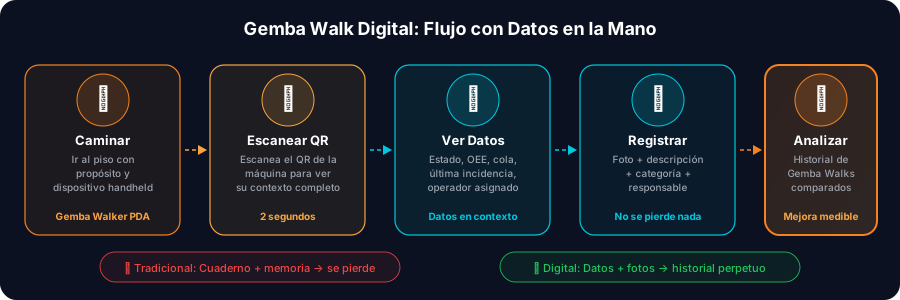
With Patok Gemba
Patok Gemba implements the digital Gemba Walk with three pieces:
1. Gemba Walker (handheld)
The supervisor walks the plant with a handheld device. Scanning each machine's QR code, they instantly see:
- Current state (running, setup, stopped)
- OEE for the shift
- Parts in queue and the current part
- The last incident logged
- The assigned operator
They no longer walk blind. They walk with data superpowers.
2. Logging Observations
Every finding is recorded in the system:
- Photo + description + the machine it belongs to
- Category (safety, quality, productivity, 5S)
- Priority and assigned owner
3. Remote Gemba Walk
With the Digital Twin you can do a virtual Gemba Walk: open your laptop and see the state of the whole plant in real time. It does not replace going to the floor — but it fills the gap when you cannot be there in person.
How Often Should You Do a Gemba Walk?
| Role | Recommended frequency | Duration |
|---|---|---|
| Line supervisor | Daily (every shift) | 15-20 min |
| Production manager | 2-3 times a week | 30-45 min |
| Plant manager | 1-2 times a week | 30 min |
| Operations director | Every two weeks, or monthly | 1 hour |
The rule: the higher the level, the lower the frequency but the greater the depth. And with a Digital Twin, senior levels can "walk" the plant virtually every day.
Conclusion
The Gemba Walk is probably the highest-impact, lowest-cost Lean practice there is. All it takes is a leader standing on the floor, observing with humility. But strengthened with digital data, it becomes a transformation tool: you go from "I think there's a problem on the CNC" to "the data shows the CNC is at 38% availability today because of 3 setup stoppages."
That difference — between intuition and data — is what separates the plants that improve from the ones that only talk about improving.
To see how the Gemba Walk connects to the whole digital Lean ecosystem, read our Guide to Lean Manufacturing in the Digital Era.
Want to experience a digital Gemba Walk in your plant? Book your free diagnostic — we walk your plant with you, data in hand, and show you what was always there.
Topics
Related Articles
More on Lean Manufacturing
Ready to transform your plant?
Book a free adoption session and find your biggest opportunity to improve with industrial AI.
Book an Adoption Session