How to Implement a Digital Twin Without IoT or Sensors
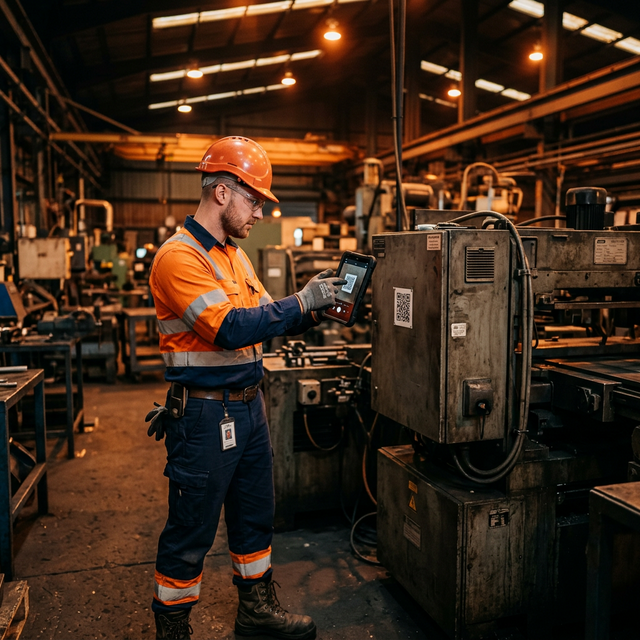
You don't need IoT sensors to have a manufacturing Digital Twin. Learn how to build real-time operational visibility using QR codes, tablets and digital human capture.
How to Implement a Digital Twin Without IoT or Sensors
The number one objection we hear from plant engineers in Latin America when Digital Twins come up is: "We don't have IoT on our machines."
They're right — most industrial small and mid-size companies in the region run machines with no modern PLCs, no vibration sensors, no OPC-UA gateways. They have 15-year-old CNC lathes, manual mills, mechanical presses, assembly stations with pneumatic tooling. The big integrators quote them $10K-$50K per machine just to instrument it.
But here is the key point that changes everything: you don't need machine signals to have a useful Digital Twin. You need operational event data — and the operator generates that.
The Premise: Digital Human Capture
In discrete manufacturing (where you count parts, not liters), the key operational events are:
- Operation start: the operator begins processing a part
- Operation end: the part leaves the machine
- State change: stoppage, setup, maintenance, waiting for material
- WIP movement: the part goes from one workstation to the next
None of these need sensors. They need a fast way to log them that the operator can use in under 3 seconds without interrupting their work.
The answer: a QR code and a mobile device.
How It Works in Practice
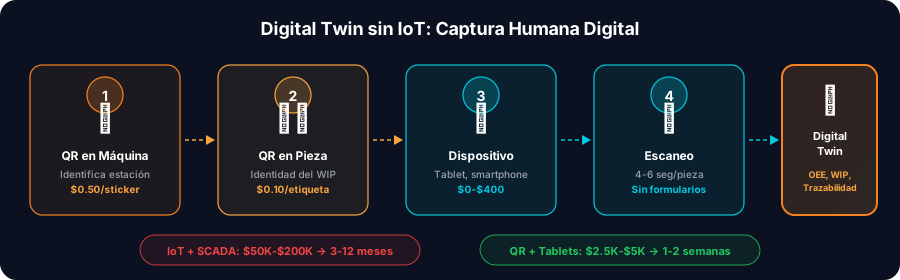
Step 1: A QR Code on Every Machine
Every machine or workstation gets a QR code stuck somewhere visible. That code identifies the machine and lets people interact with it digitally.
Cost: $0.50 per laminated sticker.
Step 2: A QR Code on Every Part (WIP)
Every part in process gets a QR label the moment it is created (first operation). That label is its digital identity for its whole journey through the plant.
Cost: $0.10 per label with a thermal printer.
Step 3: A Capture Device
The operator uses one of three devices to scan:
| Device | Use case | Investment |
|---|---|---|
| Kiosk (fixed tablet) | High-volume stations, operators who stay put | $200-$400 (Android tablet + mount) |
| Personal smartphone | Small plants, just starting out | $0 (they already have one) |
| Industrial handheld | Supervisors, Gemba Walks, warehouse | $300-$800 |
Step 4: The Operator's Flow
- The operator takes a part from their work queue
- Scans the part's QR code → the system logs the operation start with a timestamp
- Processes the part as usual
- Scans again when finished → the system logs the end with a timestamp and computes cycle time
- If there's a stoppage, they scan the machine's QR code → logs the stoppage with a reason (one tap)
Total time the operator spends: 4-6 seconds per part. Two scans of 2-3 seconds. No forms, no keyboards, no paper.
What Data Do You Get Without Sensors?
From those scans alone, the system automatically computes:
Time Metrics
- Real cycle time by part, product, machine and operator
- Lead time for each part from creation to packing
- Setup time (logged as a state change)
- Downtime by category (failure, material, operator)
Efficiency Metrics
- OEE broken down into Availability, Performance and Quality
- Throughput per hour, shift and day
- Utilization of each machine
Flow Metrics
- Real-time WIP: how many parts sit at each workstation
- Bottlenecks: where WIP piles up
- Takt time vs cycle time: are you keeping pace with demand?
- Queue per machine: how many parts are waiting to be processed
Traceability
- The real route of every part (where it went, how long it spent at each workstation)
- Who processed each part (the logged operator)
- Complete history accessible by QR: scan the finished part and see its whole life
What You Do NOT Get Without Sensors
Let's be honest. There are things human capture cannot do:
| Data | With IoT | Without IoT |
|---|---|---|
| Machine RPM | ✅ | ❌ |
| Process temperature | ✅ | ❌ |
| Vibration (predictive maintenance) | ✅ | ❌ |
| Electrical consumption | ✅ | ❌ |
| Automatic part counting | ✅ | ❌ (the operator logs it) |
| Automatic stoppage detection | ✅ | ❌ (the operator logs it) |
But here is the perspective: 90% of operational decisions don't need RPM or temperature. They need to know whether the machine is running, how many parts it has made, whether there is a bottleneck, and whether the delivery is going to make it.
For that 90%, digital human capture is enough. And you can start this week — no integration project, no cabling, no automation vendor.
The Implementation Plan: 5 Days
Days 1-2: Setup
- Define your machines and their layout in the platform
- Print QR codes for every machine and workstation
- Install tablets at key stations (optional — you can start with smartphones)
Day 3: Training
- Train operators on the scanning flow (15 minutes per person)
- Assign a "champion" per line to support their colleagues
- The rule: if it's easier than sending a WhatsApp, they will use it
Days 4-5: Live Pilot
- Start with one line or one area of the plant
- Don't try to cover everything on day one — start where it hurts most
- Watch the data in the Digital Twin in real time
Week 2 and Beyond: Expansion
- Use the pilot data to show the team the results
- Expand to the other lines
- Start using the data for real decisions: bottlenecks, setup times, load balancing
The Objection: "But the Operator Won't Do It"
This is the favorite objection of managers who have never implemented digital capture. The reality:
- If the scan takes under 5 seconds, adoption runs above 90%.
- If the operator sees a direct benefit — their work queue in order, their OEE visible — they adopt it fast.
- If the system is required to start the operation (you can't process without scanning), compliance is 100%.
Patok Gemba was designed around this philosophy: the operator interface is touch-first, readable with gloves on, and works offline. It is not an ERP form adapted for manufacturing — it is an industrial tool built for the floor.
Conclusion
IoT is fantastic when you need it and can afford it. But waiting for IoT before implementing a Digital Twin is like waiting for a Ferrari before going to work — you'll arrive very late.
Digital human capture (QR codes + tablets + a cloud platform) gives you 90% of the operational visibility you need at 10% of the cost of IoT. And you can start in days, not months.
Does your plant have machines with no automation? Perfect. With a $0.50 QR code and a smartphone, you already have the entry point to your Digital Twin.
For the complete guide to Digital Twins in manufacturing, read our pillar article.
Want to see how it works in your plant? Book a free diagnostic Gemba Walk — we bring a tablet and map your line in under an hour, no sensors required.
Topics
Related Articles
More on Digital Twin
Ready to transform your plant?
Book a free adoption session and find your biggest opportunity to improve with industrial AI.
Book an Adoption Session