What Is an Industrial Digital Twin? Concept, Benefits and Examples
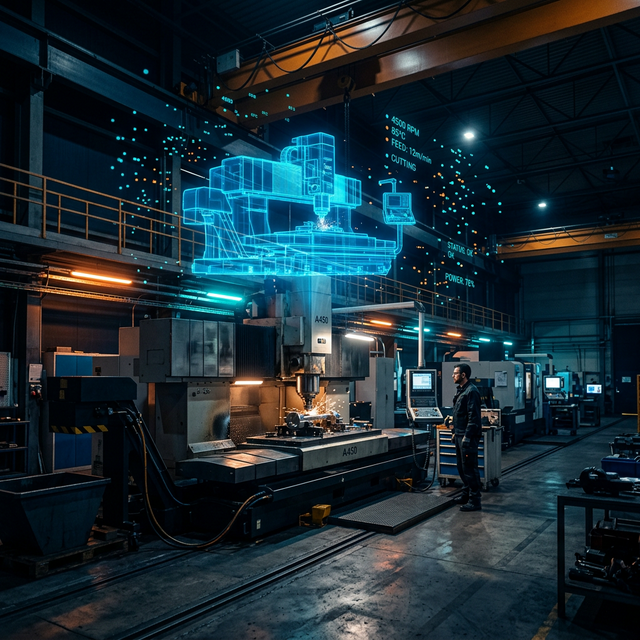
Understand what an industrial Digital Twin is, how it works in manufacturing, its real benefits, and why it is the most important tool for plants that want operational visibility.
What Is an Industrial Digital Twin?
If you work in manufacturing, you have probably heard the term Digital Twin at conferences, in articles, or in vendor presentations. But between all the marketing, the definition has gone fuzzy. Is it a 3D render? Is it IoT? Is it just a dashboard under a new name?
Let's clear it up.
A Simple Definition
A Digital Twin is a real-time digital representation of a physical system. In manufacturing, that system is your plant: machines, parts in process, operators, material flows.
It is not a static copy. It is not a drawing. It is not yesterday's dashboard. It is a living model that changes second by second as the physical world changes.
When the operator starts the machine, the Digital Twin reflects it. When a part moves from one workstation to the next, the Digital Twin knows. When a bottleneck forms, the Digital Twin shows it before anyone on the floor notices.
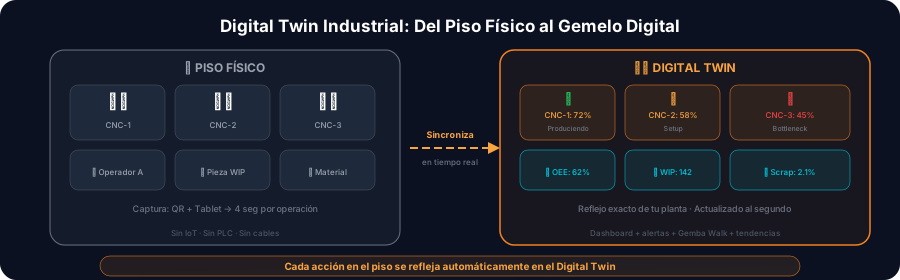
How Does It Work in a Plant?
1. Capturing Data From the Floor
The Digital Twin needs data from the real world. There are two routes:
- IoT sensors: direct signals from PLCs, vibration and temperature sensors, and so on. High investment, second-by-second granularity.
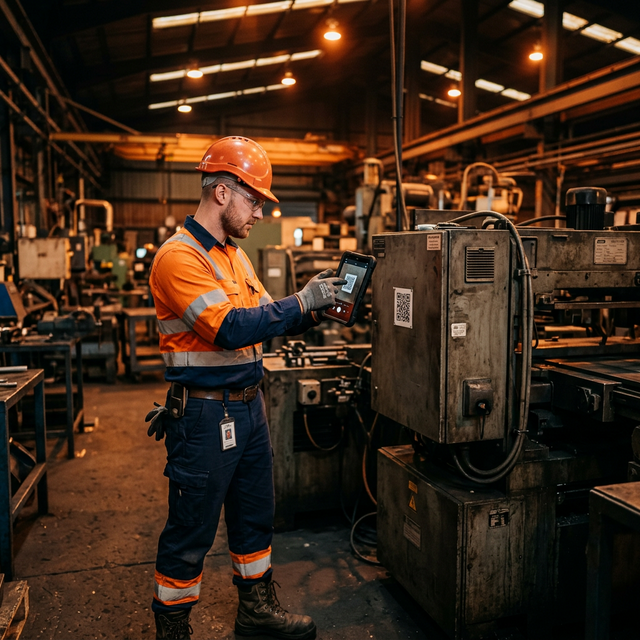
- Digital human capture: operators scan QR codes, log events on a tablet, use handheld scanners. Low investment, event-level granularity.
For most plants in Latin America, the second route is more practical and more affordable. Read more about that approach in Implementing a Digital Twin Without IoT.
2. The State Engine
Raw data is processed in a state engine that understands your plant's logic:
- Machine-3 is in the "Running" state
- It holds Part #347 from Work Order #4521
- It is 1.8 min into a standard cycle time of 2.0 min
- There are 12 parts queued and waiting
3. Real-Time Visualization
The model is presented in an interface that can be:
- A plant layout: machine cards positioned the way they sit on your real floor
- A metrics dashboard: OEE, throughput, lead times
- A flow view: how WIP moves through the workstations
The Patok Digital Twin combines all three: you see your plant as a layout, each machine shows its metrics live, and you can trace any part from creation through packing.
What Is It For? Concrete Benefits
Visibility Without Walking
Benefit number one. You don't need to be on the floor to know what is happening. From your office, another plant, or your home, you see the complete state of production.
Catching Problems Early
A machine stoppage that used to be discovered two hours later — when somebody happened to walk past — now shows up immediately as an alert. Bottlenecks are caught as they start to form, not once they have already cost you two days.
Decisions Based on Data
"Should we add a shift?" With a Digital Twin, that question is answered with data: the real utilization of each machine, the idle time, the OEE. Without a Digital Twin, the answer is a hunch.
Traceability of Every Part
Every WIP (part in process) is tracked from creation through delivery. You know exactly where it went, how long it sat at each workstation, and who processed it. That is gold for quality audits, ISO, and customer claims.
Production Meetings That Work
The daily meeting goes from "what happened yesterday?" (with data on paper) to "what is happening right now?" (with the Digital Twin on screen). Decisions in 15 minutes instead of 45-minute debates over imprecise numbers.
Who Uses It Inside the Plant?
| Role | How they use it |
|---|---|
| Operator | Sees their work queue, current part and target cycle time on the workstation kiosk |
| Supervisor | Monitors every machine on their line, gets alerts for stoppages or deviations |
| Production Manager | Reviews OEE by line, work order load, bottlenecks, schedule adherence |
| Plant Manager | Consolidated multi-line view, efficiency indicators, improvement trends |
| Operations Director | Multi-plant view where applicable, high-level KPIs, ROI of the digitization |
Digital Twin vs Other Systems
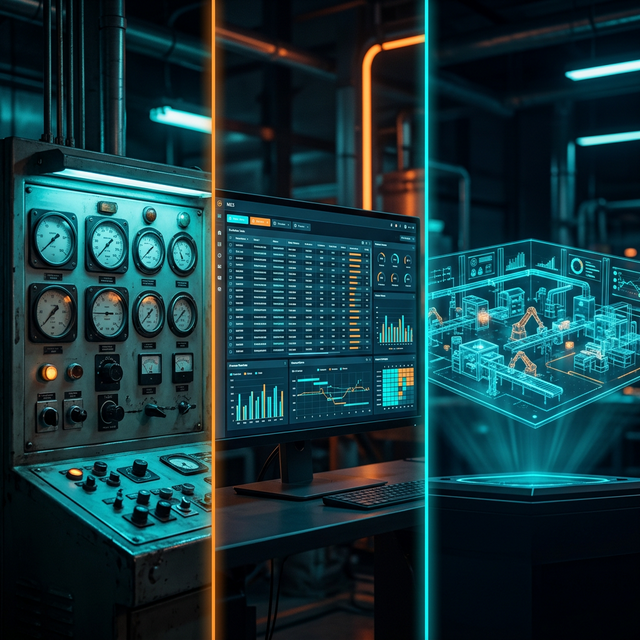
A frequent mistake is confusing the Digital Twin with systems you already have. The key difference:
- SCADA controls machines (signals, alarms, PID loops). It does not model production flows.
- MES executes production orders (scheduling, dispatch, lots). It is transactional, not visual.
- ERP runs the business (finance, purchasing, sales). It has no visibility of the floor.
- Digital Twin models the real state of the floor in real time. It is the visibility layer the other systems don't have.
For a detailed comparison, read Digital Twin vs SCADA vs MES.
Is It Only for Large Companies?
Definitely not. The concept was born at NASA and made popular by global automakers with budgets in the millions. But today, with cloud platforms and mobile devices, a 10-machine plant can have a working Digital Twin in a week.
Patok was designed for exactly this scenario: industrial small and mid-size discrete manufacturers in Latin America that want operational visibility without investing in expensive IoT or a 12-month integration project.
Conclusion
An industrial Digital Twin is, in essence, the answer to a simple question: "What is happening in my plant right now?"
If answering that today means walking to the floor, calling the supervisor, or waiting for tomorrow's report, a Digital Twin changes your operational reality. It is not a technological luxury — it is the basic visibility infrastructure every plant needs.
Want to go deeper? Read our Complete Guide to Digital Twins in Manufacturing, with architecture, implementation and detailed use cases.
Ready to see your plant in real time? Explore the Patok Digital Twin and transform the visibility of your production.
Topics
Related Articles
More on Digital Twin
Ready to transform your plant?
Book a free adoption session and find your biggest opportunity to improve with industrial AI.
Book an Adoption Session