How to Prepare Your Plant for a Digital ISO 9001 Audit

A practical guide to preparing your manufacturing plant for ISO 9001 audits using digital records. Less paper, more evidence, audits without the stress.
How to Prepare Your Plant for a Digital ISO 9001 Audit
The scene is familiar: the ISO 9001 audit is a week away and the plant goes into survival mode. The quality team hunts for missing records, supervisors fill in overdue routing sheets, and the manager prays the auditor won't ask about the February lot nobody documented.
It doesn't have to be this way.
A plant that runs on digital records doesn't "prepare" for audits — audits simply get answered. The evidence exists, it is organized, and it is accessible in seconds.
What the ISO 9001 Auditor Is Really Looking For
Many quality teams obsess over documents — manuals, procedures, work instructions. But an experienced auditor knows documents are easy to manufacture. What they are really looking for is evidence that the system works in practice.
The 5 Key Clauses for Manufacturing
| ISO 9001 clause | What it assesses | What evidence you need |
|---|---|---|
| 7.1.5 Control of monitoring and measuring resources | Are your instruments calibrated? | Calibration records with dates |
| 8.5.1 Control of production and service provision | Do you control your processes? | Production records, process parameters |
| 8.5.2 Identification and traceability | Can you trace a product? | Lot or part traceability |
| 8.6 Release of products and services | Do you verify before delivering? | Inspection records, acceptance criteria |
| 10.2 Nonconformity and corrective action | Do you manage problems? | Nonconformity records, corrective actions, effectiveness |
If you can answer those 5 clauses with digital data, 80% of your audit is settled.
The Paper Problem: Why Audits Hurt So Much
The Reality of Paper Records
In a typical plant running on manual records:
- Routing sheets that get lost, get oil on them, or never get filled in
- Inspection records that don't match the parts produced ("the inspector left without signing")
- Machine logs with entire shifts left blank
- Audit binders that get "prepared" the week before by backfilling data
- Corrective actions documented but never implemented (though the form says otherwise)
The result: weeks of preparation, a stressed team, and the permanent risk of a nonconformity for missing evidence.
What Paper CANNOT Do
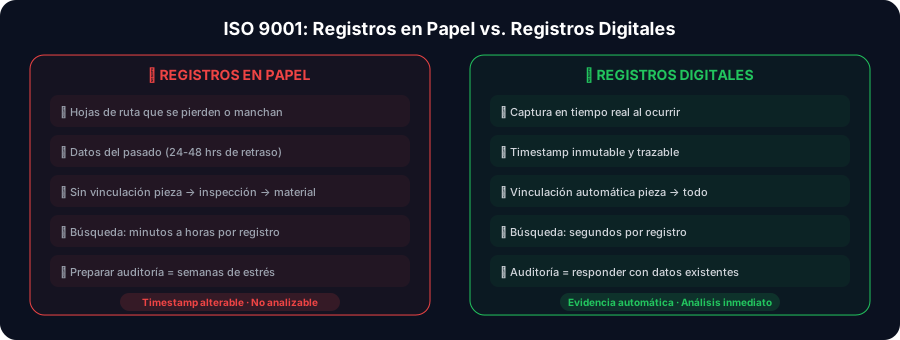
- No reliable timestamp: was that sheet filled in at the time, or a week later?
- No connections: the production sheet isn't linked to the inspection or to the raw material
- No alerts: if a parameter goes out of range, nobody finds out until somebody reviews the sheet — if anybody does
- No analysis: you cannot trend nonconformities across 200 sheets in a binder
Digital Records: The Fundamental Difference
A digital record is not "scanning paper and saving it as PDF". It is capturing structured data at the moment it happens, tied to the part, the machine, the operator and the exact time.
What Changes With Digital Records?
| Aspect | Paper record | Digital record |
|---|---|---|
| Moment of capture | End of shift (if remembered) | In real time, as it happens |
| Integrity | Can be altered without a trace | Immutable, traceable timestamp |
| Linkage | Manual ("see binder 3, page 12") | Automatic (part → operation → inspection) |
| Search | Minutes to hours | Seconds |
| Analysis | Impossible without later digitization | Automatic (trends, Pareto, correlations) |
| Availability | The binder is in the quality office | Accessible from any device |
Example: Demonstrating Traceability to the Auditor
With paper: "One moment, let me find the routing sheet for lot 2834… I think it's in the February file… here it is, but the inspection section wasn't filled in… let me look for the inspection record separately…"
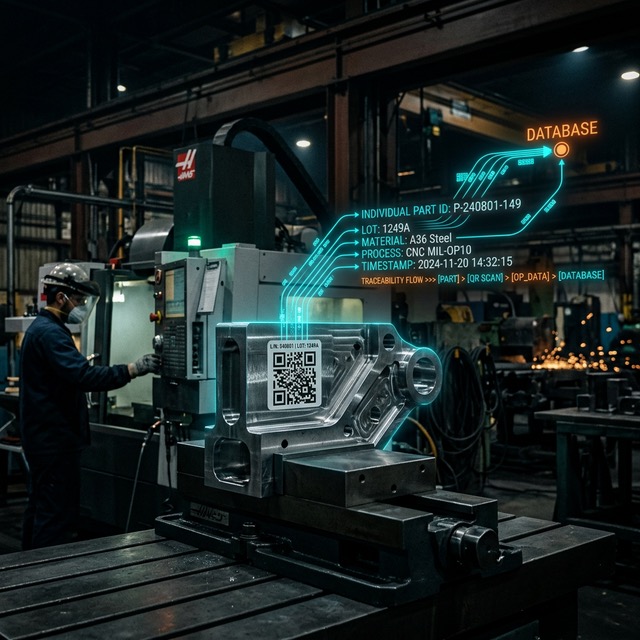
With Patok: scan any part's QR code → the complete history on screen: raw materials, every operation, operator, cycle times, inspections, evidence photos. All linked, all timestamped, all immutable.
The auditor is impressed. You didn't break a sweat.
How to Prepare Your Plant for a Digital ISO 9001 Audit
1. Digitize the Production Records
The foundation of everything. Every production operation must be logged digitally:
- What was produced (product, part, lot)
- Where it was produced (machine, workstation)
- Who produced it (operator)
- When it was produced (automatic timestamps)
- How much was produced (part count)
With a system like Patok Gemba, this happens automatically as the operator scans the machine's QR code and starts or ends their operation. No forms, no handwriting.
2. Link Inspections to Production
The inspection record must be tied to the part, not on a separate sheet. When the inspector scans the part, they:
- See which product it is and which specifications apply
- Log the result (conforming / nonconforming)
- Attach a photo if there is a visual finding
- The result stays associated with that part's history forever
This directly satisfies ISO 9001 clause 8.6 (release of products).
3. Set Up Process Alerts
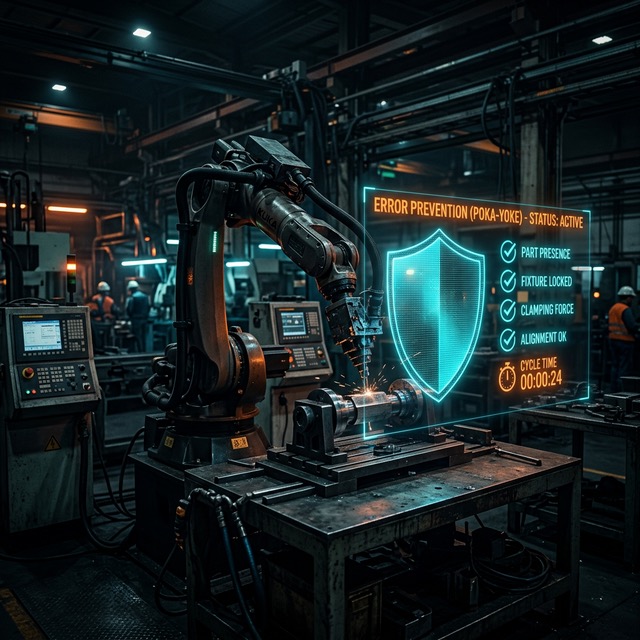
ISO 9001 requires you to control your processes (8.5.1). With digital records you can configure:
- An alert if cycle time exceeds the standard by more than a defined percentage
- An alert if OEE drops below a threshold
- An alert if a recurring defect is detected on the same machine
- A pending-inspection alert if a part moves on without being inspected
The auditor asks: "How do you control your processes?" You answer: "With automatic real-time alerts." Checkmate.
4. Manage Nonconformities in the System
Clause 10.2 is where most plants fail. Not because they have no problems — everyone does — but because they don't document how those problems were handled.
A digital system should let you:
- Log the nonconformity with evidence (photos, data, context)
- Assign a corrective action with an owner and a deadline
- Follow up to closure
- Verify effectiveness — did the problem recur?
5. Prepare Your "Digital Tour" for the Auditor
Instead of the traditional walk through the plant ("look, here's the records binder"), offer the auditor a digital tour:
- Open the Digital Twin and show the plant's current state
- Pick any part in process and show its complete history
- Show the OEE trends of the last 3 months
- Show the nonconformity log and its corrective actions
- Generate a report for any period the auditor asks for, in seconds
The 7 Records ISO 9001 Requires, and How to Digitize Them
| ISO 9001 record | Clause | How to digitize it |
|---|---|---|
| Equipment calibration | 7.1.5 | Records with dates, expiry alerts |
| Personnel competence | 7.2 | Operator profile with certifications and training |
| Product requirements | 8.2.3 | Specifications linked to the product in the system |
| Production control | 8.5.1 | Automatic operation logging with Patok |
| Traceability | 8.5.2 | A QR code per part with complete history |
| Inspection and release | 8.6 | Inspection record tied to each part |
| Nonconformities | 10.2 | Digital management with follow-up and closure |
Benefits Beyond the Audit
Digitizing records isn't only about "passing the audit". The operational benefits are enormous:
Real-Time Visibility
You go from reviewing past data to seeing your operation live. The Digital Twin shows the state of every machine, every part in process and every operational metric in real time.
Data-Driven Decisions
Instead of intuition ("I think CNC-3 is the one that fails most"), you have data: "CNC-3 is at 52% OEE because of setup stoppages averaging 42 minutes." That is a digital Gemba Walk with superpowers.
Lower Cost of Poor Quality
With part-level traceability and linked inspection records, you can:
- Catch defects before they accumulate
- Run surgical recalls instead of mass ones
- Identify root causes with data, not opinions
Common Mistakes When Preparing an ISO 9001 Audit
1. "Digitizing" = scanning paper
Scanning sheets and saving them as PDFs in a shared folder is not digitization. It is an expensive photocopier. Real digitization = structured, searchable, linked, analyzable data.
2. Over-documenting
ISO 9001 doesn't ask you to document everything — it asks you to document what is necessary to ensure your processes are effective. 50 procedures nobody reads are worse than 10 everybody follows.
3. Preparing for the audit instead of operating well
If your team has to "prepare" for the audit by backfilling records, your management system isn't working. A good system generates evidence as a by-product of normal operation.
4. Confusing compliance with improvement
ISO 9001 has an entire clause (clause 10) dedicated to improvement. The auditor doesn't only want to see that you comply — they want to see that you improve. Your OEE, cycle time and bottleneck data are your best evidence of continuous improvement.
Conclusion
In 2026, preparing an ISO 9001 audit with paper binders isn't just inefficient — it is a risk. The standard expects your system to work in practice, not only on paper. And the best way to prove it works is with digital data generated automatically as part of your daily operation.
The transition doesn't have to be traumatic. Start by digitizing production logging and inspection with QR codes. In one week you will have more reliable evidence than a year of routing sheets produced.
For a complete step-by-step guide to the digitization process, read our article on how to digitize your plant in 5 steps.
Is your next ISO audit approaching and you want real digital evidence? Book a free diagnostic Gemba Walk — in an hour we show you how your production records become automatic audit evidence.
Topics
Related Articles
More on Traceability & Quality
Ready to transform your plant?
Book a free adoption session and find your biggest opportunity to improve with industrial AI.
Book an Adoption Session