Patok vs a Traditional ERP: Which Do You Need First?
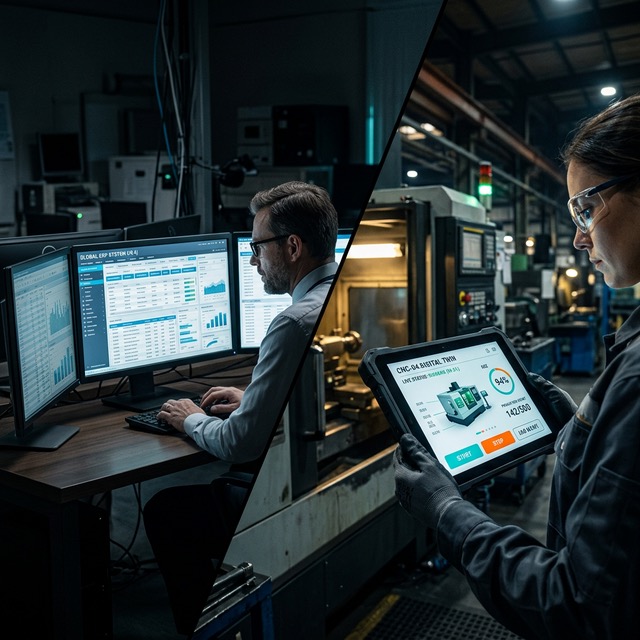
An honest comparison of Patok and a traditional manufacturing ERP. Understand what each one solves, what it costs, and which is the right starting point for your plant.
Patok vs a Traditional ERP: Which Do You Need First?
"We need an ERP."
That sentence gets repeated like a mantra at industrial small and mid-size companies everywhere. And in many cases it is true. The problem is that for most plants, an ERP is not what they need first — and buying one prematurely can be one of the most expensive decisions in their history.
Let's make the honest comparison. No marketing, no agenda. Just data and context.
What Does an ERP Solve?
An ERP (Enterprise Resource Planning) is a business management system. Its main focus is the administrative layer of the business:
| ERP module | What it manages |
|---|---|
| Finance | Accounting, receivables/payables, costs |
| Purchasing | Purchase orders, suppliers, receipts |
| Inventory | Raw material and finished goods warehouse |
| Sales | Quotes, orders, invoicing |
| Production (if included) | Production schedule, routings, BOM |
| HR | Payroll, attendance |
An ERP tells you how much material you bought, how much you sold, what you hold in inventory, and how much money comes in and goes out. It is essentially the company's administrative nervous system.
What an ERP Does NOT Solve
An ERP does not see the production floor. Specifically:
- ❌ It doesn't know whether CNC-3 is running or stopped right now
- ❌ It doesn't compute OEE in real time
- ❌ It doesn't show where each part in process is
- ❌ It doesn't detect bottlenecks automatically
- ❌ It doesn't record cycle times per operation
- ❌ It gives the operator no feedback on their performance
- ❌ It doesn't let you run a digital Gemba Walk with data in hand
An ERP knows you released production order #4521. But it doesn't know whether it is running, where it is, how far along it is, or whether it will arrive on time.
What Does Patok Solve?
Patok is a production floor platform — its focus is the operational layer:
| Capability | What it solves |
|---|---|
| Digital Twin | Real-time visibility of the whole plant |
| Operation logging | Every part, machine and operator, with timestamps |
| Automatic OEE | Availability, Performance and Quality computed to the second |
| Traceability | Part by part with individual QR codes |
| Gemba methodologies | Sprint, Flow, Tag, Check, Flex — adapted to the type of manufacturing |
| Visual management | Mieruka with feedback screens at every workstation |
| Quality management | Inspections tied to the part, digital Poka-Yoke |
Patok knows that part WIP-003421 is on CNC-3, is 3.2 minutes into a 4.0-minute standard cycle, was cut 45 minutes ago on saw #2 by Carlos, and that its raw material came from lot #2834 from supplier MetalMax.
The Direct Comparison
| Dimension | Traditional ERP | Patok |
|---|---|---|
| Focus | Business management (finance, purchasing, sales) | Operational management (production, quality, traceability) |
| Main users | Administration, accounting, purchasing | Operators, supervisors, production engineers |
| Real-time data | No (transactional, in batches) | Yes (events to the second) |
| Interface | Forms, tables, reports | Visual, touch-first, designed for gloved hands |
| Hardware | Desktop computers | Tablets, smartphones, kiosks |
| Initial investment | $50K - $500K+ | $3K - $6K |
| Monthly cost | $2K - $20K | $200 - $800 |
| Implementation | 6 - 24 months | 1 - 2 weeks |
| Success rate at SMBs | 40-60% (¹) | 90%+ (through simplicity) |
| Visible ROI | 12-24 months | 1-4 weeks |
| Computes OEE | No (or needs an expensive add-on module) | Yes, automatically |
| Part-by-part traceability | No (by lot, if configured) | Yes, natively |
| Organizational change | High (roles, processes, permissions, workflows) | Low (gradual adoption) |
(¹) According to Panorama Consulting, 60% of SMB ERP implementations run over budget and 50% run over schedule.
Complementary or Competing?
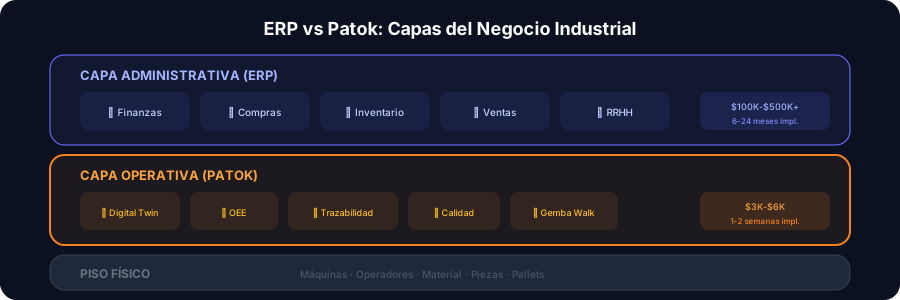
Complementary. They operate at different layers of the business:
ADMINISTRATIVE LAYER (ERP)
  Finance → Purchasing → Inventory → Sales → HR
  ───────────────────────────────────────────────
OPERATIONAL LAYER (Patok)
  Digital Twin → OEE → Traceability → Quality → Gemba Walk
  ───────────────────────────────────────────────
PHYSICAL LAYER
  Machines → Operators → Material → Parts → Pallets
The ERP manages the business. Patok manages production. Ideally you have both, connected. But the order of implementation matters a great deal.
Which Do You Need FIRST?
You need the ERP first if…
- You have no financial control (you don't know your real margin, your costs live in somebody's head)
- You have no formalized purchasing process
- You don't invoice properly or don't control receivables
- You have more than 50 employees and need systematic payroll
- Your main problem is administrative, not operational
You need Patok first if…
- You don't know your real OEE (or don't measure it at all)
- You can't answer "how are we doing today?" without asking somebody
- Setups take 50% longer than you think
- Quality claims take days to investigate
- Your operators fill in paper routing sheets (or fill in nothing)
- Your main problem is a lack of visibility on the floor
The Golden Rule
If you call your plant tomorrow at 4 PM and ask:
- "How many parts have we made today?" — if they can't answer in 30 seconds, you need Patok.
- "How much did we spend on material this month?" — if they can't answer in 30 seconds, you need an ERP.
Most industrial SMBs can answer the second question (they have an accountant) but not the first. Which is why most of them need operational visibility first.
The Most Expensive Mistake: Buying an ERP to Fix a Shop-Floor Problem
We see it over and over:
- The plant knows "something is wrong" in production
- They sign an ERP "with a production module" ($200K+)
- After 12 months of implementation, the production module is configured
- But the operators hate the forms the ERP puts in front of them (15 mandatory fields just to start an order)
- The data going in is incomplete or late
- The manager still doesn't know what is happening on the floor
- And now there is $200K+ of debt
The problem was never administrative — it was operational visibility. And an ERP is the wrong tool to solve it.
For the full comparison of shop-floor technologies, read our article on Digital Twin vs SCADA vs MES.
The Smart Path: Floor First, Administration Second
Phase 1: Digitize the Floor (Weeks 1-4)
Implement Patok on your key machines. In two weeks you have:
- Real OEE for every machine
- Part-by-part traceability
- Visibility of bottlenecks
- Cycle time and setup data
Investment: ~$5,000. ROI: visible in the first week.
Phase 2: Improve With Data (Months 2-6)
With visibility, you start improving:
- You standardize setups (30-40% reduction)
- You attack bottlenecks
- You cut scrap with digital inspections
- Your OEE climbs 10-15 points
The monthly savings from digitization pay for the ERP investment.
Phase 3: ERP With Real Data (Months 6-12)
Now implement an ERP — with an enormous advantage: you already have real data about your operation. You know your cycle times, your scrap rates, your real capacity. The ERP gets configured with real information, not the manager's estimates.
And the Patok ↔ ERP integration gives the ERP what it never had: real-time shop-floor data.
What If I Already Have an ERP?
If you already have an ERP in place, Patok becomes the shop-floor layer it was missing. Your ERP keeps managing finance, purchasing and sales. Patok adds:
- Real-time OEE (not available in most ERPs)
- Part-by-part traceability with QR codes
- A visual Digital Twin of the floor
- Operator feedback through Mieruka
- Automatic operation logging (without the operator ever touching the ERP)
The ERP + Patok combination is more powerful than either one alone.
Conclusion
The question isn't "Patok or ERP?" — it is "which first?" And for most manufacturing SMBs the answer is clear: solve shop-floor visibility first, then formalize the administration.
An ERP without floor data is a blind system managing numbers that don't reflect reality. Patok without an ERP is a plant that sees its operation but hasn't formalized its administration. Ideally you have both — but start where the impact is largest and the investment is smallest.
Not sure what your plant needs first? Book a free diagnostic Gemba Walk — in an hour we assess your operational maturity and recommend the smartest path for your case.
Topics
Related Articles
More on Practical Comparisons
Ready to transform your plant?
Book a free adoption session and find your biggest opportunity to improve with industrial AI.
Book an Adoption Session